
Free Resource
Active Rest - Relieve pain, decompress your spine, and release chronic tension
A beginner’s guide
Active Rest is an active recovery state for your musculoskeletal system. It is a foundational practice of the Alexander Technique and is best explored with an Alexander Technique teacher, especially on the first occasion. However, here’s some information to give you an idea of what’s involved.
Ideally this should be done every day. Evening is a good time but in cases of pain and discomfort it is very helpful to lie in Active Rest at lunch time or in the afternoon as well if possible. For maximum spinal decompression and release of excessive muscle tension it is best to spend twenty minutes in Active Rest, but a shorter time would also be of benefit.
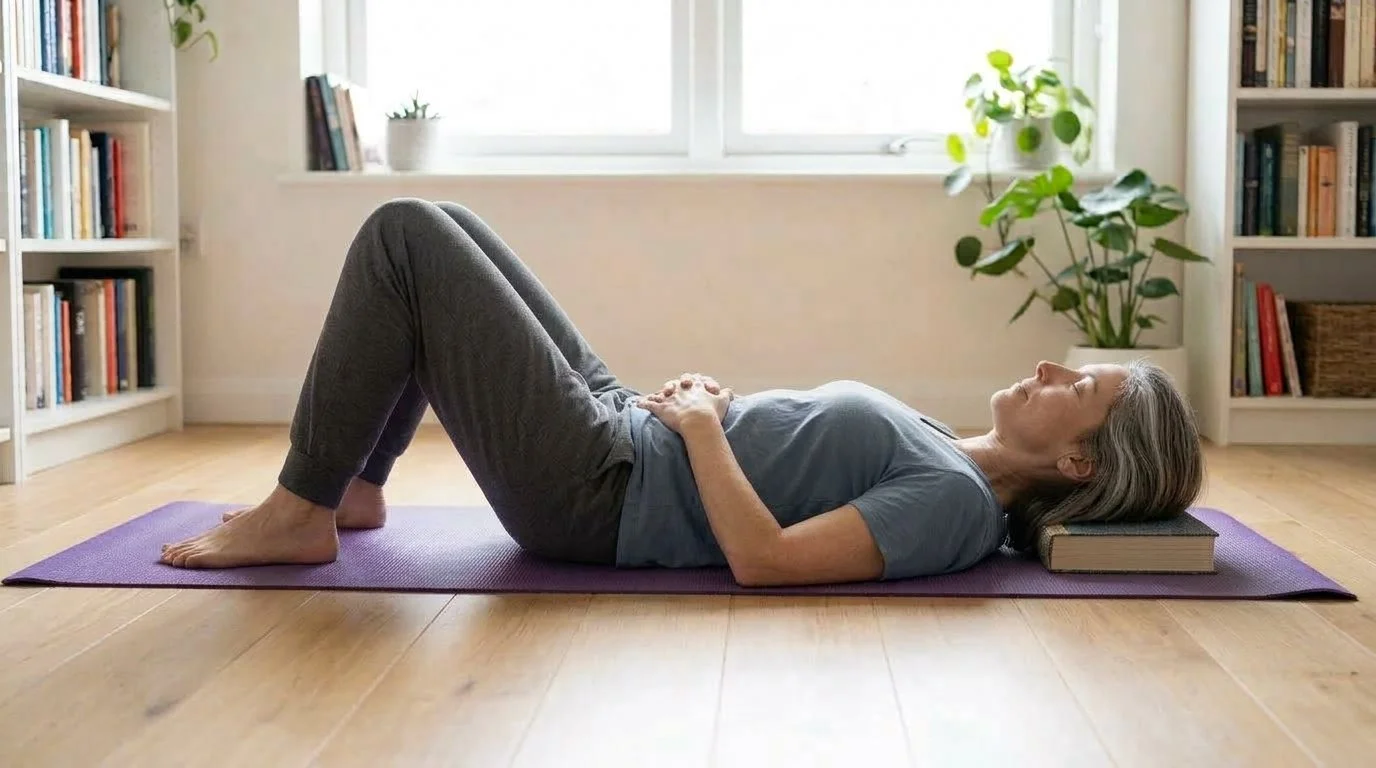
How it can help
Benefits
Although you may not notice anything happening, positive changes are taking place in your musculoskeletal system during Active Rest.
Specifically:
Tight, shortened muscles release and lengthen.
Chronically shortened muscles will regain their elasticity and length over time with regular Active Rest practise.
The absorbent intervertebral discs rehydrate.
Your spine lengthens as it decompresses. Intervertebral discs become compressed due to our habits of excessive muscular tension as well as gravity acting vertically downward on the spine all day.
Over time, and with practice, we become more aware of our individual holding patterns; and increasingly skilled at releasing unnecessary muscular tension.
Mistakes to avoid
Using a soft pillow:
Pillows lack structure. A soft pillow pushes your chin down toward your chest, compressing your throat. Use a stack of paperback books instead. They provide a firm, stable surface that allows the base of your skull to release.
The Book Stack:
If your book stack is too high, your chin will jam into your throat, making it hard to swallow. If it is too low, your head will tilt backward, arching your neck and pulling it out of alignment. What you don’t want is for your head tilting backwards so more books is better than less.
Closing Your Eyes:
It is tempting to treat this like having 40 winks, but closing your eyes often causes you to drift off or get lost in internal thoughts. Keep your eyes open with a soft open gaze. The goal of the Alexander Technique is conscious awareness—learning to be present, alert and relaxed in your environment simultaneously.
Muscling Your Position:
Do not force anything. Let gravity do the work. Trying to “do release” leads to muscle activity, a contraction, which causes a tightening, shortening and a narrowing of the muscles – the opposite of what we want. (There is more information about the bear trap of trying to release muscle tension in the first blog about ‘trying’).
Your lesson
Getting Started
1. The Surface:
A firm, flat floor (use a yoga mat or carpet). Avoid soft beds.
2. The Head Support:
A stack of paperback books. No soft pillows.
3. The Head Check:
Face roughly level with the ceiling. Chin not jammed down, head not tilting back.
4. The Legs:
Knees bent, pointing straight up. Feet flat on the floor, hip-width apart.
5. The Arms:
Hands resting gently on your stomach or lower ribs, elbows wide out to the sides.
6. The Eyes:
Kept open with a soft, relaxed, wide-angle gaze.
Now what…
Notice that you have arrived onto the floor and the books. Take in where you are and that you are completely supported by a firm surface.
Let the weight of your head rest fully on the books. You don't need to hold your head up anymore; the books have its weight entirely. Feel the firm, steady support of the floor beneath your shoulder blades, your pelvis, and the soles of your feet.
Keep your eyes open with a soft, panoramic gaze. Take in the ceiling and the peripheral space around you. You are not tuning out the world; you are waking up to it.
Notice your breathing. Feel the gentle rise and fall of your hands on your stomach. Don't try to breathe deeply—just observe the breath exactly as it is right now.
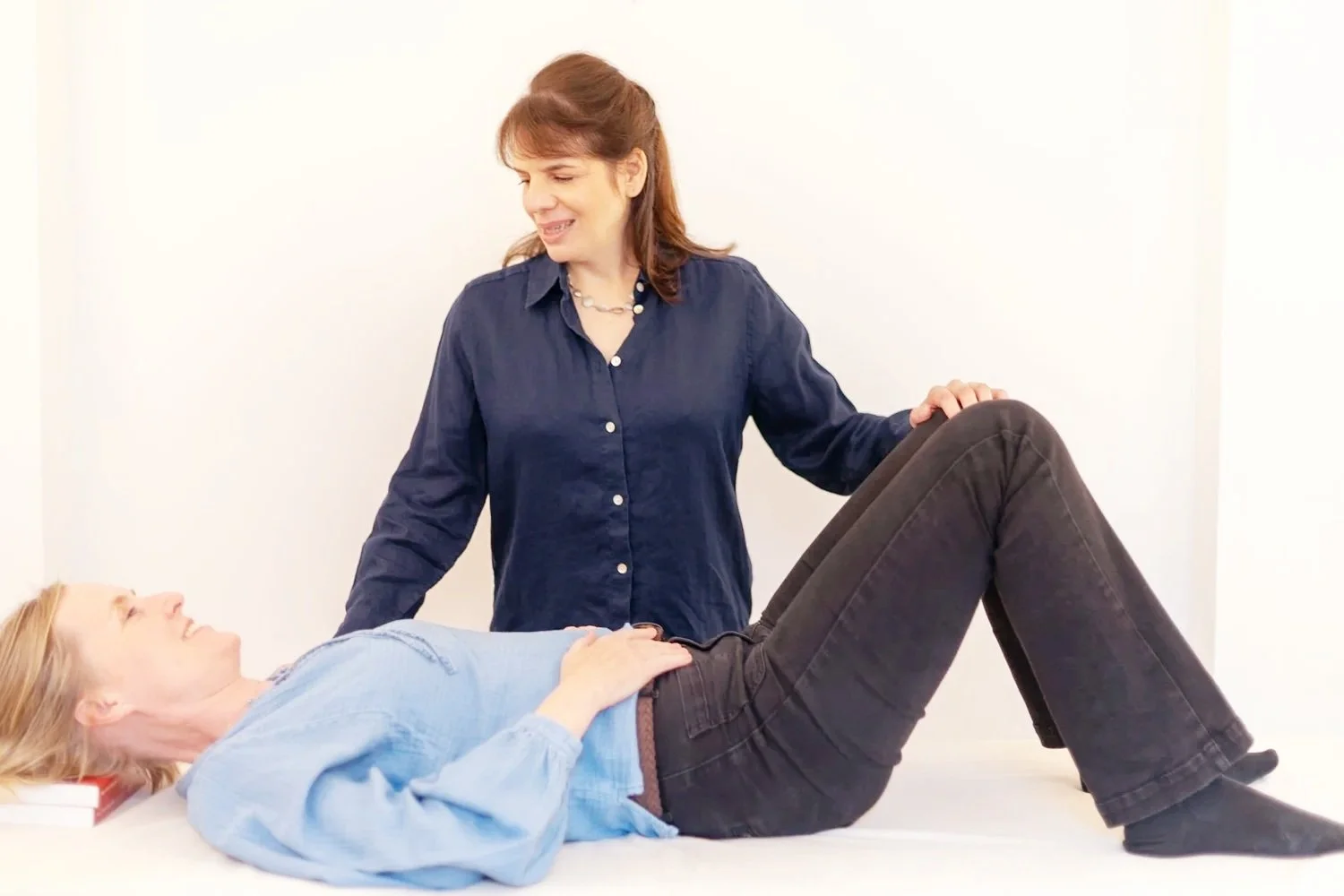
Foundations
Turn your attention to the points of contact between your body and the floor.
These are your foundations. You do not need to hold yourself up anymore; let the ground carry your full weight.
The Back of the Head
Bring your awareness to the back of your head resting on the books. Notice where the skull makes contact. Let the weight of your head be supported by the books. You don’t need to hold onto your head - or your chin.
The Shoulders and upper Back
Notice how they rest against the floor or where they may be holding. Let go of any need to do anything (i.e. using muscular effort) to release areas that may be fixed or holding on.
Backs of arms and elbows.
Notice how they rest against the floor or where they may be holding. Let go of any need to do anything (i.e. using muscular effort) to release areas that may be fixed or holding on.
The Pelvis and Sacrum
This is the heaviest part of your torso. Let it sink. If you notice a space between your lower back and the floor, do not try to flatten it by tilting your pelvis. Simply allow the weight of the pelvis to settle into the ground.
The Soles of the Feet
Sense the contact of your heels, the outside edges of your feet, and the balls of your feet against the floor.
Even though your knees are bent, your feet are actively supporting your legs. So ensure you aren't gripping your toes or rolling onto the sides of your feet.
Integrating the Whole Frame
Take a panoramic view of all four areas at once: head, shoulders, pelvis, and feet.
Sense that the floor is rising up to support you at every single point.
You are entirely supported. Let go of the need to 'do' anything and simply let your weight be supported where it contacts the floor – and sense what a relief this is!